Installation Location Selection
The selection of the product installation site must be based on a comprehensive evaluation of safety, operational efficiency, and long-term reliability to ensure stable system operation and achieve expected performance and service life.
The BESS features an IP66 protection rating, permitting installation in both indoor and outdoor environments.
The climate environment and geological conditions, such as stress wave emission and underground water level, should be fully considered when selecting the installation site.
The installation site should be away from areas where toxic and harmful gases are concentrated, and free from inflammable, explosive, and corrosive materials.
It is suggested the product be installed in a place away from the residential area. Ensure the distance and noise level meet the local laws and regulations. If the requirements cannot be met due to geographical restrictions, use noise mitigation measures. For details, consult with the designer or SUNGROW.
Do not install the the product in dusty environments with a large amount of dust, smoke, or floc. These particles may cling to the product's air inlets/outlets or heat sink, thus impairing its heat dissipation performance or getting it damaged.
Do not install the product in places where corrosive gas or dust may be produced or accumulated, or in places within 30 km of saline-alkaline land or pollution-generating industrial complex such as chemical plants and power plants (chemical gas class: 1C1, solid particle level: 1S2).
Do not install the product in environments contaminated with halogen or sulfur pollutants.
There are no underground facilities at the site.
The product must be installed out of reach of children.
Installation Environment Requirements
The product should be installed in a dry, well-ventilated place.
Do not install the product in environments with direct sunlight, standing water, snow accumulation, or excessive dust. To ensure stable operation, it is recommended to install the product in an area with adequate shelter or protection.
-
The system operating temperature range is -20°C to 55°C.
Note:The BESS may derate if the ambient temperature is excessively high.
The BESS charging power may decrease if the ambient temperature is excessively low.
Relative humidity at the installation site: 0–100%, non-condensing.
-
During installation and maintenance, prevent water or foreign objects from entering the Pack connectors. (Outdoor installation and maintenance are prohibited in rainy or dusty conditions.)
Installation Orientation
Install the BESS vertically. Do not install the system upside down, horizontally, or on its side.
Installation Foundation Requirements
Mount the BESS securely. Based on the installation layout, use either the battery retention strap or the base mounting bracket to prevent the unit from tipping over.
The mounting surface must not be combustible and must possess fire-resistant properties.
Ensure the mounting surface is structurally sound and capable of supporting the equipment's weight.
The flatness of the installation foundation surface shall be ≤ 5 mm. For details, see BESS Installation.
If the installation site is assessed to have no flood risk, the foundation construction work may be omitted.
Installation Clearance Requirements
For effective heat dissipation and ease of maintenance, it is recommended to reserve sufficient space around the equipment during installation. A minimum horizontal clearance of 600 mm and a minimum vertical clearance of 900 mm shall be maintained between the battery system and all potential ignition sources, including but not limited to hot water systems, heat pumps, and other electrical equipment. The required clearance around the BESS (using 200 kWh as an example) is shown in the figure below.
The recommended installation space is applicable for scenarios where there are no obstructions above the equipment.
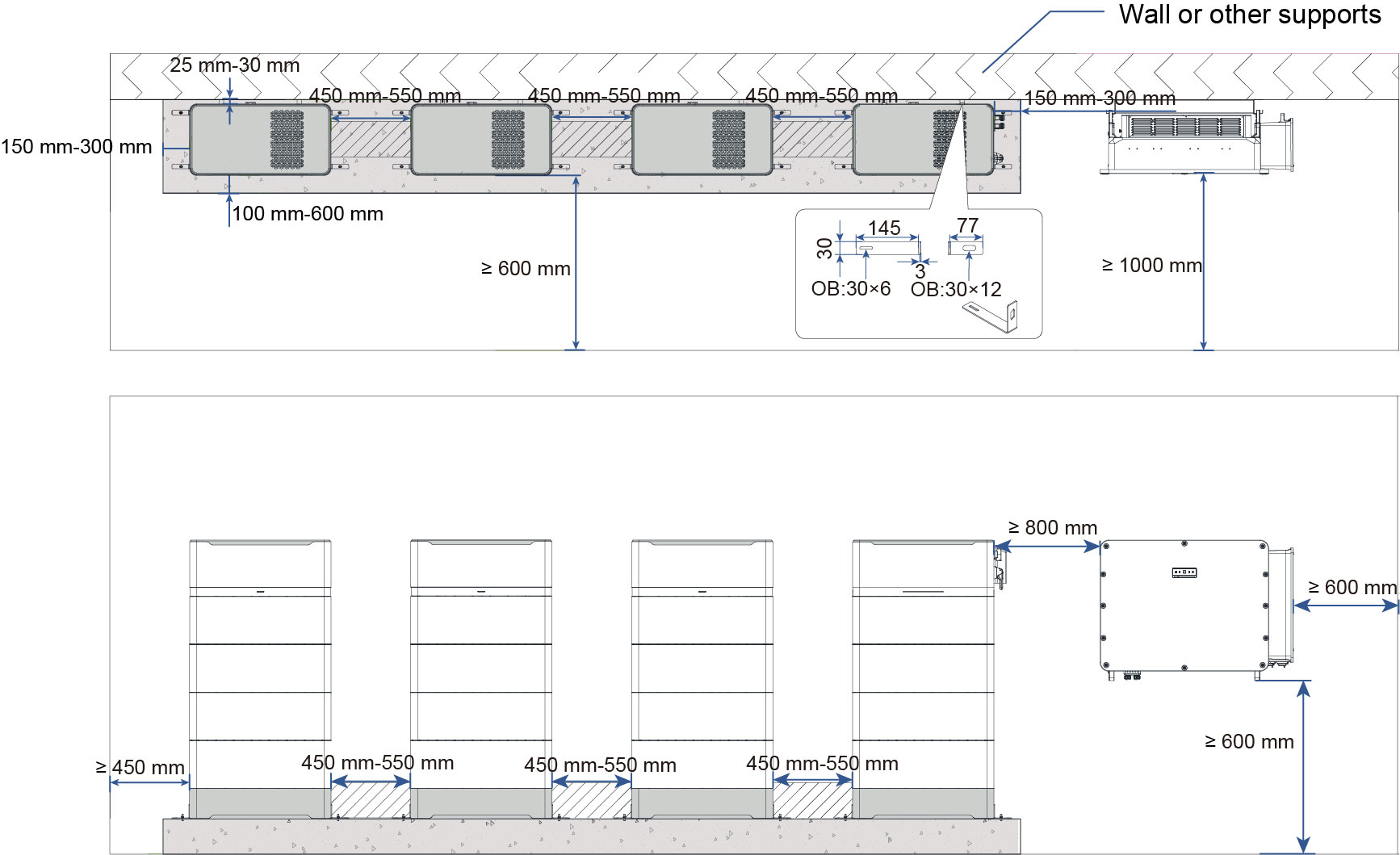
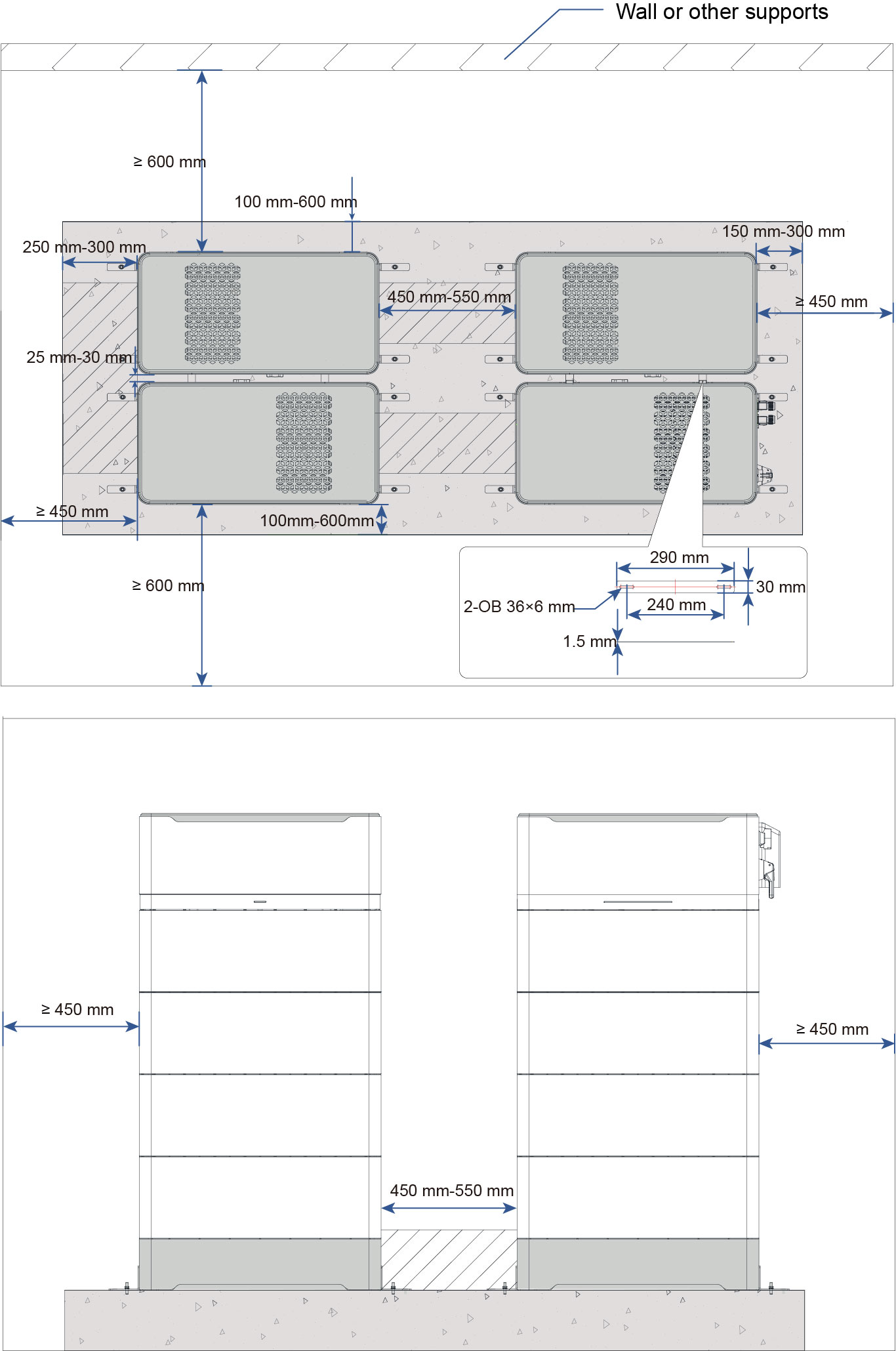
When the BESS is arranged in this layout, the layout of the hybrid inverter should be determined based on actual on-site conditions. It is recommended that the plant design for the BESS refer to this layout, while the hybrid inverter should be installed according to the requirements specified in its respective manual. The installation distance between the BESS and the hybrid inverter shall be ≥ 800 mm.
If the product is installed indoors or where significant obstructions exist in the exhaust air duct, additional ventilation equipment is required to assist with heat dissipation. For long-term stable system operation, the recommended environmental conditions are as follows: The ambient temperature of the BESS shall not exceed 35°C, the ambient temperature of the inverter shall not exceed 40°C, and the ventilation rate shall be ≥ 2200 m3/h.
If the indoor space is a container, the inner walls must be lined with rock wool of ≥ 50 mm thickness.
For outdoor installations, if the product's sides or top are significantly obstructed by large shaded areas, resulting in a clearly impeded exhaust air path, it shall be treated equivalently to an indoor installation.
For other layout requirements, contact SUNGROW for corresponding layout guidance.